Category Archives: Ambitious Science Teaching

Focusing a Crosscutting Concept Lens

In previous posts, I’ve written about integrating the crosscutting concepts (CCCs) in curriculum. The CCCs are a set of thinking tools, or epistemic heuristics, for science. Each CCC can be imagined as a lens through which we examine phenomena. Each lens reveals a different aspect of the phenomenon that should be included in an explanation of how the phenomenon works. In this post, I present a way to coherently integrate the CCCs into a curriculum unit.

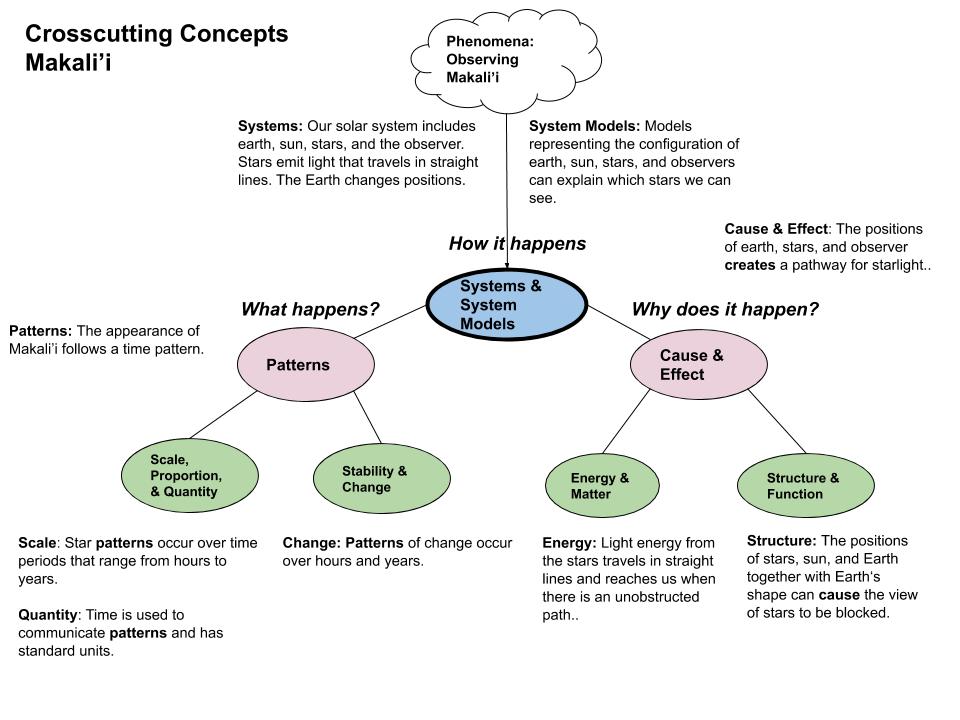
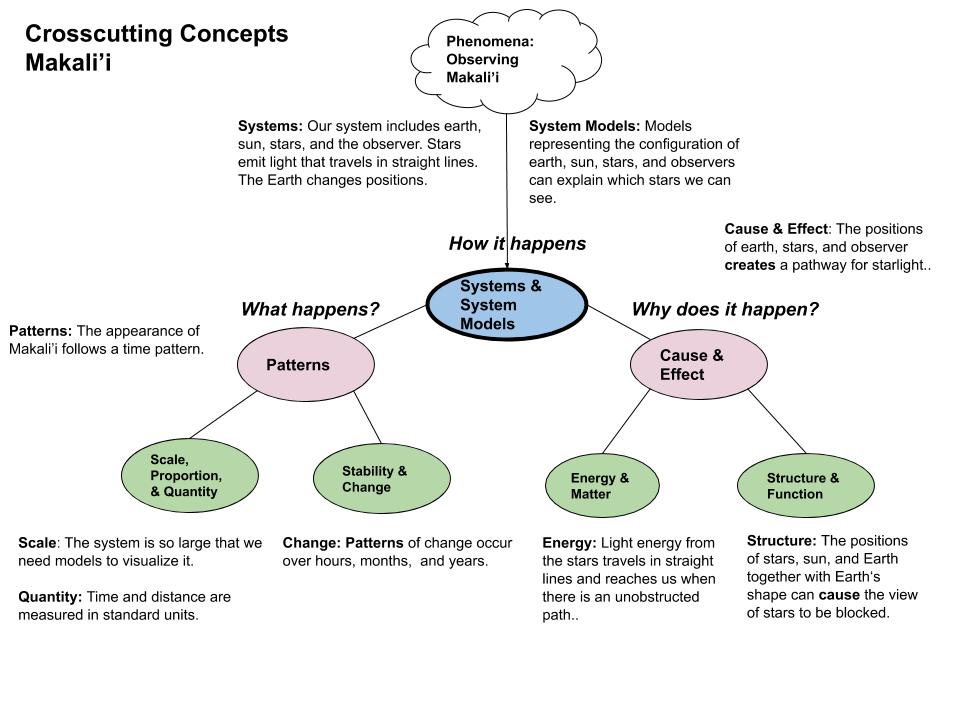
I’ve used my graphic organizer to identify how each CCC applies to the phenomenon. The figure below is for the phenomenon of Makali’i rising at sunset each November, which is an indication for the start of the Hawaiian new year. In this post I will illustrate how to weave the CCCs into instruction over the course of a unit. Each of the CCCs is introduced in the unit as their investigations reveal related aspects of the phenomenon.
Systems and System Models is the Foundation

A key feature in the unit is student modeling. Systems and System Models is the foundational CCC (blue oval in the figure). At the beginning of the unit students create a system model that reflects their initial understandings. The model should include the important parts and how the parts interact. Students revisit the model two more times in the unit, at the middle and near the end. In the middle of the unit students refine the model using evidence from their investigations. Near the end of the unit students refine the model again to integrate their new understandings and explain the anchoring phenomenon. These refined models should address more CCC elements.

Begin Modeling with the Basics – Patterns and Cause & Effect

At the beginning, modeling should focus on the two first-order CCCs – Patterns and Cause & Effect (pink ovals in the figure). Students identify patterns in the phenomenon and attempt to explain the cause of the patterns. They do not yet know the cause and effect relationships that explain the phenomenon. This is a good time to elicit students’ ideas and create a class list. Teachers can offer sentence starters for students to record their ideas about the cause and effect relationships. After individual think time and small group sharing, teachers can gather ideas from the whole class into a list that is a class resource for modeling.

Next, students work in small groups modeling the phenomenon. Teachers can ask questions that help students use the other CCCs and focus their thinking. Based on the ideas a student has, teachers can focus a student’s thinking on a specific part of the phenomenon using focusing questions.

Focus Student Thinking with Remaining CCCs

The teacher should have a list of questions written in advance that target each of the CCCs as they apply specifically to the anchoring phenomenon. Let’s look at examples for the phenomenon of the rising of Makali’i. STEM Teaching Tool #41 is helpful for creating good focusing questions.

Scale, Proportion, and Quantity

  • Can an observer on Earth see the cause of the changes in the constellations that we see?
  • Is the cause too large or does it take too long to see directly?
  • How can a model make this cause easier to see?

Stability and Change

  • What explains why we see different constellations over a year?
  • What explains why the same constellation returns every year at the same time?

Energy & Matter

  • How does energy (light) travel in this system?
  • What causes an observer to see a constellation?

Structure & Function

  • How do the spatial relationships among the parts of the system cause the observer to be able to see a constellation?

Teachers should select which questions to ask based on what ideas students are trying to express in their models. The purpose of questioning is to elicit what students already know and help them express their ideas in models. The questions should not be used to try to change students ideas at this point. The teacher needs to use their judgement to determine which questions will help student thinking and which questions are not productive at this point in the unit.

Revising Models After Investigations

At the middle and near the end of the unit, students revisit their models to improve them. The focusing questions listed above can be refined to ask students to address how new evidence might be included in their models. For example, in the Makali’i unit students learn how Earth’s rotation makes the sun and stars appear to move over the day and night. They learn how the same motion can look different from different frames of reference. A person sees the Earth as stationary and the stars moving, while a person in space sees the stars as stationary the Earth rotating. Teachers can revise the focusing questions to help students examine how this finding affects their models. Here are some examples for two CCCS.

Stability and Change

  • How does the Earth’s rotation explain why our view of the sky from Earth changes?
  • How does the Earth’s rotation explain why constellation rise and set each evening?

Structure & Function

  • How does the Earth’s rotation affect our ability to see a constellation from Earth?

These revised focusing questions help student think about how to integrate their new knowledge into their models.

In this way, we can strategically integrate all the CCCs through iterative modeling and discourse tools. It may be that some CCCs are not helpful for certain phenomena. It may be better to introduce some CCCs later in the unit rather than at the beginning. Those decisions would be made on a case-by-case basis.

What do you think about these ideas? Let me know in the comments or on Twitter.
Revolutionizing Science Education with Vernier Connections powered by Penda

Vernier Connections, in collaboration with Penda Learning, revolutionizes science education by enabling students to actively engage in investigative learning. This program emphasizes real-world phenomena and employs Vernier sensors for data collection, fostering critical thinking and scientific practices. It aligns with NGSS standards while providing structured, student-centered experiences that enhance comprehension and inquiry.

Transforming a Physics Lessons about Wave Properties

Are you transforming your physics course to NGSS? I took an old lesson of mine about properties of waves and transformed in to a phenomenon-driven storyline. The original activity was an inquiry-based lesson on wave properties. You can find it on the PhET website. I wanted to update this lesson to align with the NGSS…
Developing a Particle Model of Matter

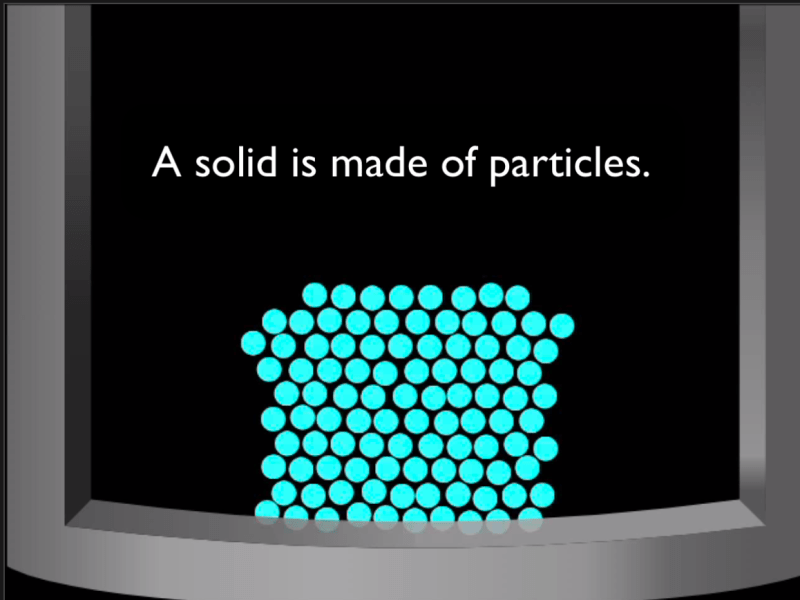
On September 15, we started Lesson 2-3 of The Garbage Unit. This lesson develops the idea that solids and liquids are made of particles and uses this idea to explain sugar dissolving in water. The day before this lesson, students made predictions about what happens to sugar when we dissolve it in water. Most students…


Crosscutting Concepts

By Dr. Lori Andersen, June 2020

The crosscutting concepts are the “thinking tools” of science. These seven big ideas help us describe and explain our world. Why is it important to use them as a set rather than individually, as they are presented in the standards?

A phenomenon is an object, process, or event. A phenomenon can be something very ordinary. It doesn’t have to be anything phenomenal. All phenomena are either a system or a part of a system. This is why systems and system models is the foundational crosscutting concept (Rehmat et al., 2019) and the arrow in the diagram points from phenomenon to systems and system models.

Systems and system models are tools for describing and explaining systems. A system model is a representation of the components and how they interact. The systems model can include pictures and text. The most important feature of the systems model is that it explains how the phenomenon happens.

Patterns are tools for describing what happens. There are many different kinds of patterns we might notice. We describe patterns using two other crosscutting concepts — scale, proportion, & quantity and stability & change.

Cause and effect is a tool for explaining why something happens. Cause and effect relationships can be simple or complex. We explain cause and effect using two other crosscutting concepts — matter & energy and structure & function.

The diagram provides a way to think about how the CCCs operate together as we create system models. In phenomenon-driven instruction, we are going to use many CCCs rather than just one or two. The idea for this diagram came from Rehmat et al. (2019) and I modified it to include phenomenon and adjusted the representation of systems and systems models in the diagram.

By NASA, ESA, AURA/Caltech, Public Domain, https://commons.wikimedia.org/w/index.php?curid=7805481

Let’s apply the set of CCCs to an example. One phenomenon is the rising of Makali’i every November, which is used to mark the beginning of the Hawaiian new year.

Makali’i is a group of stars. We see the stars because light from the stars travels to our eyes. Our system model needs to include the stars, sun, and Earth to explain why we see them.

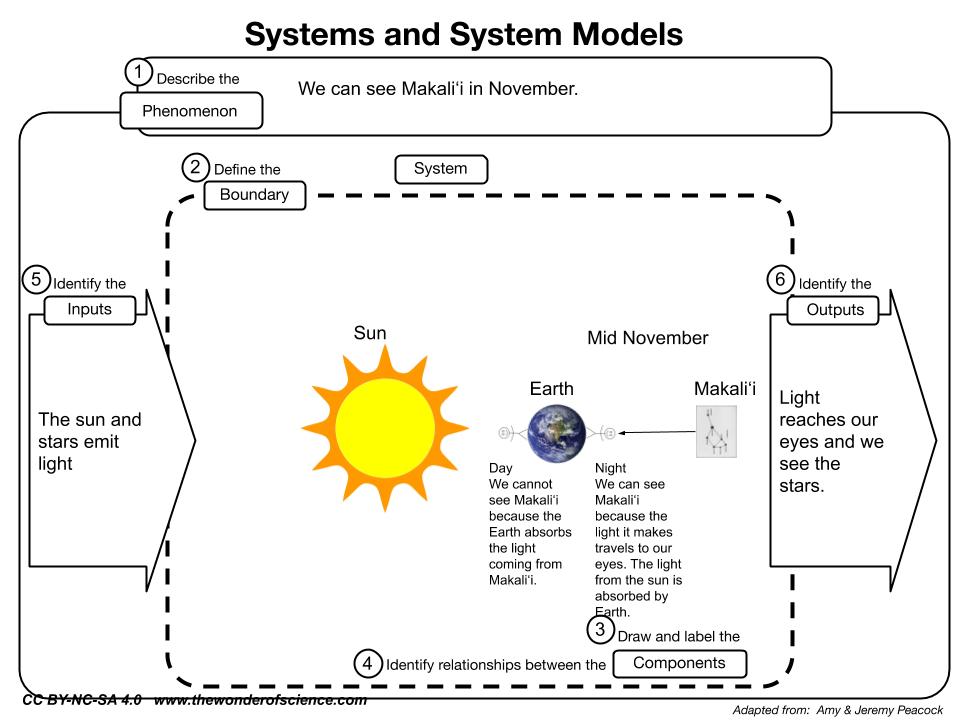
I developed this diagram using the templates on Paul Anderson’s website, Wonder of Science. These are great tools because they are already Google Draw editable documents. I added my system components and supporting text.

This system model explains how we can see Makali’i in November. Components include: Makali’i, sun, Earth, and observer. Makali’i emits light, which travels to Earth so we can see Makali’i in November. How do we use the other CCCs in the model?

Patterns are what happens in the phenomenon. There is a time pattern of specific months of the year when Makali’i can be observed in the sky. The time is measured with units (Scale, Proportion, & Quantity). Constellation patterns stay consistent over shorter periods of time, such as a month, while changing quite a bit over longer periods of time, such as a year (Stability & Change).

Cause & Effect is why the phenomenon happens. There is a cause, or reason, for the effects we observe. We observe Makali’i because the light can reach our eyes. The light can reach our eyes because the arrangement of sun, earth, stars, and the observer creates an unobstructed path for starlight. Light is a transfer of energy (Matter & Energy). The unobstructed path happens because of the structure within the system (Structure & Function). The Earth itself blocks light from reaching our eyes depending on its position in its orbit and its point in the rotation on its axis.

In the example of observing Makali’i, we see that all the crosscutting concepts play a role in describing and explaining the phenomenon. This diagram shows the role of each crosscutting concept.

So, how would you decide which to leave out? How can we use them together without overwhelming students and teachers?

What do you think about using all the crosscutting concepts in creating systems models that describe and explain phenomena? Leave your ideas in the comments!

References

Rehmat, A.P., Lee, O. Nordine, J., Novak, A.M., Osborne, J., & Willard, T. (2019).  Modeling the role of crosscutting concepts for strengthening science learning of all students. In S. J. Fick, J. Nordine, & K. W. McElhaney (Eds.), Proceedings of the summit for examining the potential for crosscutting concepts to support three-dimensional learning. University of VA. http://curry.virginia.edu/CCC-Summit

Planning Science Units with Equity in Mind

This post gets deeper into Chapter 2 of Ambitious Science Teaching. This chapter explains a systematic unit design process used to create a series of lessons that can build understanding coherently. What struck me the first time I read this chapter is how well this planning process supported creating units that embody the vision of science teaching and learning in the Next Generation Science Standards. This design process is also useful for creating problem-based learning units. This post describes the three practices in this process, how the process builds in some equity considerations, and how the process might be extended to address other equity issues.

The process consists of three major practices:

  • Practice 1: Identifying big ideas
  • Practice 2: Selecting an anchoring event and essential question
  • Practice 3: Sequencing learning activities that build specific understandings

Descriptions of each of the three practices are supported by detailed examples from work with teachers.

Practice 1 includes a whiteboard activity to help curriculum writers select the most important ideas that have the most explanatory power. Considering a tentative anchoring event can help guide this process. These important ideas become the conceptual threads that ties the unit together.

Practice 2 focuses on choosing the anchoring event. Curriculum writers should consider features that make the anchor context-rich and more compelling for their students, such as historical significance or issues of social justice that can motivate interest. See Angela Calabrese-Barton‘s Twitter feed for examples of how to incorporate social justice, such as this one about the water in Flint, Michigan. Students will model and explain the causes of an anchoring event over the course of instruction, and these explanations should integrate multiple science ideas. The anchoring event should be complex enough to provide space for students to create different kinds of explanations.

Practice 3 is a strategy for identifying and sequencing learning activities in a unit. A key part of this planning is a teacher-developed gapless explanation for the anchor event, which should be written just beyond the expectation for students at grade level. Learning activities are identified and sequenced to support development of the gapless explanation.

Although the planning process seems straightforward, there are a few other things we might consider in planning for equity. Equity is a key concept in AST (see my post on Chapter 1). The authors made strong connections between the anchoring event and equity, but they did not make connections between the gapless explanation and equity.

Who decides on the content of the gapless explanation?

Philip Bell raised an interesting question on Twitter about gapless explanations. From whose perspective are they gapless? It is important to consider explanations from multiple perspectives and not focus only the Euro-western perspective. How can different ways of knowing be recognized and developed in science teaching? There is much work to do in this area that has the potential to increase equity. We need to acknowledge and build upon the funds of knowledge that all students bring to school science. We need to expand our views of science as a way of knowing to be more inclusive of all cultures. There is a lot of work that remains to be done in this area.

I appreciate reading the posts from my science education colleagues on Twitter that help deepen my understanding. I look forward to working with members of the #ASTBookChat group as we explore AST together.

What are your thoughts about the AST unit design process? What other ways could the unit planning process be more attentive to equity? Share in the comments!

Planning for engagement with big science ideas

This is week two of a book study of Ambitious Science Teaching (Windshitl, Thompson, & Braaten, 2018) with a nationwide group of science educators. The study was organized by @sbottasullivan. We are working through one chapter of the book each week and I will blog about each chapter. This post is about Chapter 2, Planning for engagement with big science ideas. You can follow our book study using #ASTBookChat on Twitter.

This chapter describes a unit planning process. This unit planning process is very different than the methods in which most science teachers have been trained. The rationale for this process is compelling. A anchor-driven unit has advantages over traditional topic-driven units.

Manuel Keusch

Selecting a good anchor takes time and thought, but is essential to creating a high-quality unit. The anchor must be complex enough that multiple science ideas are needed to explain it. The anchor must also be relevant to studentsʻ  lived experiences. In this way, the choice of anchor contributes to equity and rigor, which were two of the major concepts in my Chapter 1 post.

Eneida Nieves

As we design a unit, we should identify the big ideas that have explanatory power. Which ideas shed light on the inner workings of the most phenomena? The observation that often the most important big idea in a unit is not even explicitly called out in a typical unit was striking. It is important for us to equip students with the ability to use ideas with great explanatory power that can be used in multiple contexts.

fotografierende

Modeling and explanation of the anchor event are key activities in a high-quality unit. Students engage in iterative cycles of evidence gathering and sense-making as they develop their explanations. Models make their thinking visible. Our teaching goals must include explanations that include the “why” of anchor events. Teachers develop the gapless model that is the explanation of the anchor activity before they design the unit.

Anchor events are the thread that holds together the activities in the unit. The activities help students answer questions about the anchor event and are arranged in a logical order. This chapter describes a process for deciding how to order unit activities.

I am looking forward to the weekly discussion from the #ASTBookChat group on Twitter and synchronously via Zoom each week.

For more about #ASTBookChat, see my previous posts:


Reflections on CH1 ASTBookChat

Yesterday we had our first meeting for #ASTBookChat. Over 50 science educators from around the country participated either asynchronously via Twitter or synchronously via Zoom. I enjoyed this experience because we shared our perspectives on and experiences with implementing Ambitious Science Teaching ideas. Although we came from different places and roles, we share similar motivations to move toward the AST vision of equity and rigor in science instruction.

We share a motivation to improve science teaching and learning for all students because it is important work. We recognize shortcomings of the status quo and see the potential for making real change with AST and NGSS ideas. We also see that our motivation is sometimes not widely shared because others are in a different place in their professional development journeys. This relates to a video that was shared during our meeting. In the video, Dan Pink explains motivation as due to three factors: Autonomy, Mastery, and Purpose. The key to motivating teachers is not teaching them the small skills, it is sharing the why. What can happen if we change our practice and how will it impact our students? If teachers buy in to the why, they will be motivated more for learning the tools and skills because they have purpose. Then they can build on their strengths to develop mastery and move closer to the AST vision.

A vision of Ambitious Science Teaching

This week, I begin a book study of Ambitious Science Teaching (Windshitl, Thompson, & Braaten, 2018) with a nationwide group of science educators. The study was organized by @sbottasullivan. We are going to work through one chapter of the book each week and I will blog about each chapter. This post is about Chapter 1, A Vision of Ambitous Science Teaching. You can follow our book study using #ASTBookChat on Twitter.

The first thing that struck me about this chapter is the emphasis on two equally important ideas in science teaching – rigor and equity. Often I have seen efforts in science teaching or curriculum that have emphasized one of these, while not attending to the other. For example, a curriculum may focus on cultural relevance, but not provide opportunities for students to grapple with important science ideas. On the other hand, a curriculum may focus on rigor, while not attending to equity. I have seen many examples of this, including approaches that naively present science as culturally neutral.

The authors describe how there is consensus in the science education research literature about the kinds of experiences that are important in science teaching and learning. They point out four things that students and teachers should be able to do:

  1. Understand, use and interpret scientific explanations of the natural world
  2. Generate and evaluate scientific evidence and explanations
  3. Understand the nature and development of scientific knowlege
  4. Participate productively in scientific practices and discourse

Nationally, the current state of science teaching and learning reveals that these things are frequently NOT observed in K-12 science classrooms. The AST book is a “how-to” for developing the skills we need as we work toward doing the things that are important for science learning in a way that addresses equity and rigor. However, reading and understanding what needs to be done is quite different (and much easier) than doing it well in real classrooms with real students. Professional development providers and teachers need to work together to change our science classrooms.

Changing science teaching and learning is a challenging task, but it is important. By enabling students to do the four things in the list, we are preparing them to be productive citizens who can engage in discourse around issues that are important to our world. We need citizens who can evaluate evidence and explanations, and make choices that use science to act responsibly.

I am looking forward to the weekly discussions from the #ASTBookChat group on Twitter and synchronously via Zoom each week.

For more about Chapter 1`, see my post Reflections on CH1 #ASTBookChat